
Energy & Eating
When Low Energy Changes What You Reach For
Eleanor Whitfield
·

London, March 2026. Around three in the afternoon, something stalls. The energy that was serviceable in the morning — adequate to the task of paying attention, of responding, of maintaining forward motion — retreats. This dispatch documents what happens in that window: what people reach for, what they do and do not do, and what the cumulative pattern of those choices means for weight balance over time.
The afternoon energy slump — that dulling that settles in somewhere between 14:00 and 16:00 — is one of the most reliably documented patterns in the observation of daily human energy. It is not a sign of poor sleep alone, though poor sleep amplifies it. It exists even in well-rested individuals as a natural feature of the circadian rhythm.
What varies is its intensity. In people carrying a sleep debt, in those who consumed an inadequate or poorly composed midday meal, or in those who have been sedentary for several hours, the afternoon slump deepens into something more disabling. The capacity to concentrate narrows. The drive to seek something — anything — that might relieve the flatness intensifies.
This is the moment at which the afternoon energy slump and eating intersect most directly. The relief sought is almost always caloric and fast-acting. A biscuit, a sweet coffee, a handful of something from the desk drawer. The pattern is so common as to be unremarkable — which is exactly why it has gone largely unexamined in the broader conversation about weight.
"A ten-minute walk at 15:00 tends to produce a measurable change in alertness that outlasts the walk itself — often by thirty to forty-five minutes."
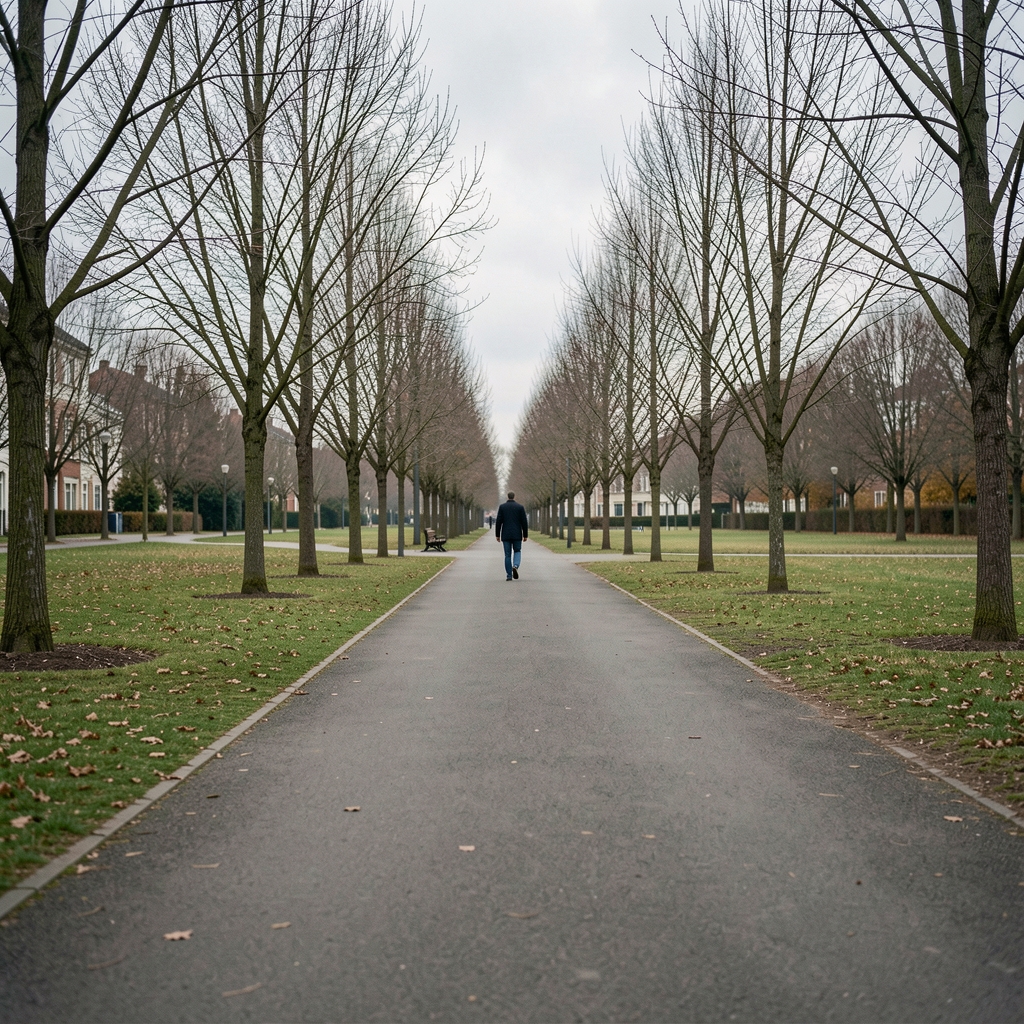
The evidence on light activity and energy during the afternoon slump points consistently in one direction: brief, gentle movement interrupts the slump more effectively than rest does. This is counterintuitive to many people who feel, in the slump, that the correct response to low energy is to do less. But reduced movement tends to extend the slump, while gentle movement tends to shorten it.
A ten-minute walk at 15:00, a slow circuit around the building, even the simple act of standing and stretching for a few minutes — these tend to produce a measurable change in alertness that outlasts the activity itself. The mechanism is not complex: gentle movement increases circulation, shifts breathing, changes visual input, and breaks the sedentary accumulation that deepens the slump.
What this means for the fatigue-food relationship is practical: if a brief walk can partially substitute for the energy-seeking food choice that the slump would otherwise produce, the daily caloric accumulation shifts. The biscuit that is not eaten because the walk was taken is not a dramatic intervention — but it is a consistent one. Over days and weeks, consistency matters more than intensity.
Movement when tired is a different proposition from movement when energised. The people whose field notes informed this dispatch were not being asked to run. They were being observed in their natural patterns — which, for the most part, involve very little movement in the afternoon window. The question of how much is enough is a relevant one.
The documentation suggests that threshold is lower than commonly assumed. The difference between a completely sedentary afternoon and one interrupted by ten to fifteen minutes of slow walking appears to be meaningful — in terms of alertness, in terms of appetite in the subsequent hour, and in terms of the person's overall sense of their own capacity. The difference between fifteen minutes of slow walking and thirty minutes of brisk walking is less significant than the difference between zero and fifteen.
This is, in the language of evidence-informed practice, a dose-response relationship with a low activation threshold. The first small dose of movement produces a disproportionately large effect. Subsequent doses produce smaller incremental effects. For someone whose chronic low energy makes vigorous activity feel impossible, this is a relevant and practical observation.
One dimension of the afternoon that receives less attention in the documentation on low-energy eating is portion awareness — specifically, how this changes during the slump. Fatigue and portion awareness are inversely related throughout the day, but the afternoon is the period where the practical implications of this relationship are most acute.
People who track what they eat reliably underestimate their afternoon and early evening consumption compared to their morning consumption. Morning eating, when the mind is sharper, is observed and registered more accurately. Afternoon eating — precisely when fatigue reduces attentiveness — is less accurately registered. The extra biscuit, the second coffee with milk, the handful that extends into a bowl: these additions are real but frequently undocumented.
This observation does not call for obsessive tracking. It calls for structural awareness: what is easily available in the afternoon window, and what patterns does that availability tend to produce? A working environment stocked with fast-release food choices, combined with afternoon fatigue, produces predictable outcomes. Changing the structural conditions — rather than relying on in-the-moment resistance — is the more durable adjustment.
How the afternoon is managed shapes the evening. A person who interrupts the slump with a brief walk, maintains reasonable attention to what they consume between meals, and arrives at the dinner hour without having accumulated a significant caloric debt, is in a different position than one who does not.
Energy management and eating are, in this respect, a continuous thread across the day — not a series of discrete meals and discrete choices, but a single sustained negotiation with one's own energy state. The afternoon is the most demanding section of that negotiation. It is where the body is most compromised and where the easiest choices are most frequently the least sustaining.
What this dispatch has attempted to document is not a list of interventions but a recognition of the pattern itself. The afternoon slump is real. Its relationship with food choices is consistent. The capacity of gentle movement to interrupt it is real. And the aggregate effect of all these small afternoon moments, over weeks and months, is not small at all — it is precisely where the longer-term weight pattern is being written, one unremarkable afternoon at a time.

Harriet Marsden is a London-based writer whose work focuses on movement, fatigue, and the observable patterns of daily energy. She contributed this piece to Ardolan Dispatch in March 2026.
Read more dispatches →